
Why and how it matters who speaks in social sciences
Introduction: mirroring Harriet Martineau
The pre-disciplinary sociology of Harriet Martineau has become part of overviews of the classics in sociology. But how special is Martineau’s approach? Characterizing and ranking Martineau in sociology is a consequence of persistent collective research into her works and positioning her in series of female sociologists and comparisons with contemporary pre-disciplinary sociologists, scientists and writers.
In this article I would like to add Jenny P. d’Héricourt to these comparisons. Why d’Héricourt? After a comparison with Auguste Comte and Alexis De Tocqueville at the 2024 Martineau Society Conferences in Lewes, it seemed interesting and important to also compare Harriet Martineau to work of a French female author with pre-disciplinary sociology aspirations. Through this comparison, a kind of mirroring, or ‘comparative profiling’, I hope to contribute to the collective knowledge on Harriet Martineau as a pre-disciplinary sociologist.
You can read or download the PDF of the article in the Martineau Society Journal, or just continue reading below.
Section 1 Jenny d’Héricourt, a very short introduction*
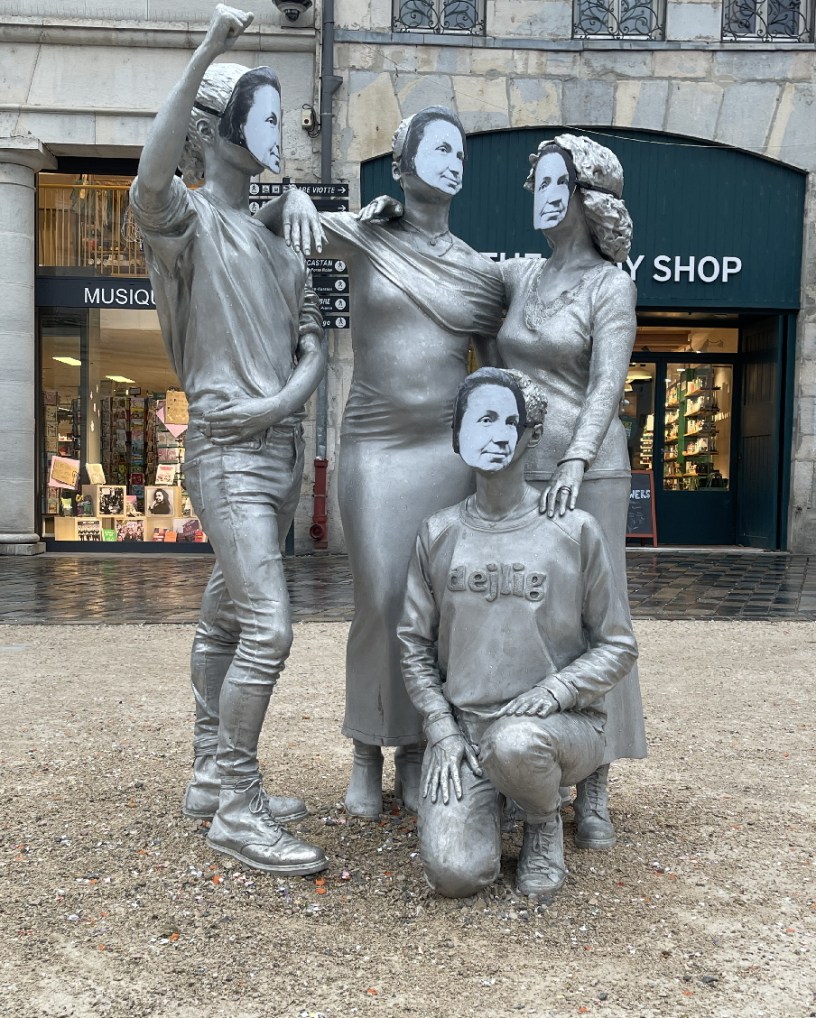
Besançon, France, 8th March 2025. An aluminium, human-sized group of four women simply titled ‘Jenny’ was unveiled. The group statue honours 19th-century women’s rights campaigner Jenny d’Héricourt. The artist of the statue, Lily Reynaud-Dewar, designed the group from 3D-scans of four citizens of Besançon, each with an activity close to those that d’Héricourt carried out during her life: a midwife, a writer, an activist and a teacher. D’Héricourt, a pseudonym of Jeanne-Marie Fabienne Poinsard (1809-1875) was born in Besançon, in the north-east of France, and the town has chosen to highlight her because of her activism in favour of women’s freedom to choose their careers (Pasquier and Le Moing, 2025).
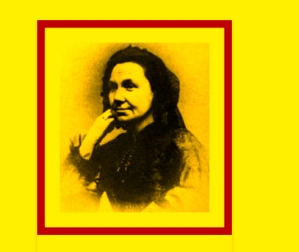
Jeanne-Marie-Fabienne Poinsard, alias
Jenny d’Héricourt
Poinsard, whom I will call by her writer’s pseudonym d’Héricourt, wanted to study medicine to become a medical doctor, but did a teacher education instead (Offen 1987; Arni 1998). After her divorce from four years of marriage (she called it afterwards not marriage but ‘sorrow’), she took private courses in anatomy, physiology and natural history. She qualified as a midwife and opened her own practice for women and children. She was also certified in homeopathic medicine. Through her medical praxis she encountered female suffering. She was a founding member of the Societé pour l’Émancipations des femmes.
D’Héricourt became disappointed with the way the ideals of the French Revolution of 1789 were practiced in resepct of women rights. An active writer during and after the 1848 revolutionary period in France, she published in different magazines and journals, also under pseudonym Felix Lamb. She was in a polemic debate with Italian writer Giulia Molino-Colombini who focused on the role of women exclusively in the domain of the family. Caroline Arni (1998:8;13) argues there are good reasons to accept D’Héricourt as part of the broader discourse of the history of the social sciences: her critical and theoretical work is grounded in her view of social realities with an analysis presented in terms of structural barriers (Arni and Honegger 2008).
A major work was published in 1860 ‘La femme affranchie‘, in English translated ‘A Woman’s Philosophy of Woman, or Woman Affranchised‘ and published by Carlton in 1864. D’Héricourt by then had emigrated in the United States of America, There, she tried to found a World Women’s League and opened a midwife-praxis. This turned out financially unsuccesful and d’Héricourt turned to teaching French and then remigrated to France with little money left. She was buried in Saint-Ouen, near Paris.
Section 2 Harriet Martineau and Jenny d’Héricourt: four comparative dimensions
There are good reasons to argue d’Héricourt and Martineau played in a similar league of intellectuals. Both have written different genres of books and articles and contributed to political debates. Both are called pre-disciplinary sociologists. Both visited the USA, which at those times (1830-1860s) had the image of being a frontier of democracy and advanced social developments. They left with idealistic expectations and returned with some (Martineau) and large (d’Héricourt) disappointment.
Both authors also had an interest in social inequalities. D’Héricourt focuses on inequal positions of women studies, often reasoning from her medical background. Martineau highlighted a.o. the unequal position of work by females in the economy, was active in a housing association and was against slavery. Both authors put science above religion, which is one of the elementary characteristics of the 19th century history of the social sciences. Although D’Héricourt does not favour religious dogmas and is critical of religion, she, contrary to the later Martineau, does not become an atheist but remains protestant throughout her life. Did these two female intellectuals meet? Or read eachother’s works? I have found no evidence so far they did, but it may be likely they had read eachother’s work, e.g. on Auguste Comte.
In the next section, I will focus on two major works, which allows for a comparison of how these two authors collected knowledge on people in society. In my analytic reading I included four interrelated knowledge dimensions: (1) ontology; (2) epistemology; (3) method and (4) view of humans. When you are interested in the history and workings of science, the first three characteristics are the more obvious elements, or to put it very under-complex: ontology is about the interrelated realities an author wishes to describe, epistemology is about how one can acquire knowledge, and methods are about the methods applied to acquire knowledge. The fourth dimension – view of humans – has been a key insight factor in forming an opinion about scientific works, ever since I started studying the social sciences and worked as a social science author. The image of humans in all its relational guises — as God’s tool, the subject of King X, a member of community Y or an autonomous individual — often determines how an author perceives the social environment and what levers of action and/or change are available. I am curious to know how Martineau and D’Héricourt differ in these aspects. And what can we learn from this first comparison to sharpen the profile of Harriet Martineau?
Section 3 Two pre-disciplinary books, two approaches to knowledge
How to Observe Morals and Manners and A Woman’s Philosophy of Woman are two very different books. Martineau’s book aims to persuade readers to look more closely at people’s manners and investigate morals and manners. She presents a number of skills with which the researcher, she refers to as the Traveller, could describe reality much better than the first passer-by, or tourist.
D’Héricourt writes A Woman’s Philosophy of Woman, as an indictment, a criticism of the work of a number of French authors and how they write about women. In the second part, she presents her views on love and marriage, captivating readers by presenting a conversation between readers, writer, mother and daughter. Her writing style is more fierce, more polemical, when compared to Martineau’s works. She strongly condemns the work of her contemporary and fellow Parisian Proudhon, and also criticises Auguste Comte, whose work Martineau has translated and about which Martineau remains much more neutral in her judgemental remarks. Both authors employ a personal writing style, without much reference to external authorities, which was normal at the time.
Dimension 1 Ontology: what is the object of study i.e. What do both authors focus on when they investigate social realities?
D’Héricourt’s social theory starts from rights in order to define functions and society. “Right” is the condition and circumstance for the development of the human species. People create rights. They live by them and develop and manifest themselves through rights. ‘Function’ is the use of the individual’s possibilities, concerned with themselves and others. And “Society” encompasses all kinds of functions, which d’Héricourt lists with these 11 functions:
1. Scientific and philosophic functions; 2 Industrial functions; 3 Artistic functions; 4. Educational functions; 5. Medical functions; 6. Functions for the preservation of safety; 7 Judicial functions; 8 Functions of exchange and circulation; 9. Administrative and governmental functions; 10. Legislative functions; 11 Functions of solidarity or of social benevolence and of institutions for the prevention of crime. (D’Héricourt 1864:225).
D’Héricourt puts this list into perspective; it is not intended to be a complete description of social organisations, and in Part II of Woman Affranchised she focuses on “love” and “marriage”. She describes the rules, rights and customs surrounding marriage. The emphasis is on the unequal obligations and rights of men and women. The concept of justice always comes first. The following quote illustrates the importance of justice:
“You understand the great destiny of our species; you understand your rights and duties; (…) and if forced to choose between family interests and generous sentiments of a higher order, woman should no more hesitate than should man to sacrifice the former to justice.” (D’Héricourt 1864:293)
In short, Héricourt puts the moral principle first: equality between individuals, and she judges the law, customs, and practices based on this principle of justice.
Martineau gives morality an important place in her book and works, in How to observe she focuses on five departments of inquiry:
‘the Religion of the people; their prevalent Moral Notions; their Domestic State; their Idea of Liberty; and their Progress, actual or in prospect.” (Martineau 1838:77)
Martineau emphasizes values such as freedom and doing good. In this context, one’s own conscience and empathy are important. As will become apparent from the following dimension.
Dimension 2 Epistemology: How can we know this object of study i.e. How do both authors explain what knowledge consists of
A key argument in Jenny d’Héricourt’s work is of epistemological nature: she argues that the facts you find or establish cannot form laws, because laws are deduced from unequal starting positions. In discussion with Proudhon and Comte, d’Héricourt criticises their uncritical acceptance of reality- as-it-is when it comes to the women’s issue. On this narrow basis, one cannot build reliable knowledge about the differences between men and women. She mentions various alleged characteristics of men and women that have no basis in truth, such as: sensible, graceful, hairlength, timid, violent, abstract reasoning, art-loving, economical, extravagant, self-sacrifice. And concludes:
“(…) the law of sexual difference is not manifested through the several characteristics which have been laid down. That these characteristics may be only the result of education, of the difference of prejudices, or that occupations etc.“ (D’Héricourt 1864:243)
According to d’Héricourt true knowledge about human nature is only possible in freedom and equality: “(…) for we can only know the nature of a human being when it has become freely developed in equality” (D’Héricourt 1864:245).
Harriet Martineau suggests a different order of analysis. In How to Observe Martineau seeks relationships with science and scientific methods. She emphasises the relationship between the various sciences in order to present a social science that allows a wider audience to participate in the path to knowledge. A science that is nevertheless different from the natural sciences, because people comment on their social reality and put it into words. Martineau’s famous quote in this context is:
“The grand secret of wise inquiry into Morals and Manners is to begin with the study of THINGS, using the DISCOURSE OF PERSONS as a commentary upon them.” (Martineau 1838:73) CAP by Martineau.
The essence of Martineau’s thinking in her methodological classic seems naturalistic and empiricist. For it is simply possible for anyone to set out to investigate social reality and ‘just’ observe. Martineau keeps emphasizing the craft of knowledge acquisition, whereby knowledge is always possible and better knowledge arises when the researcher focuses on a number of conditions or skills to be learned. This brings us to methods.
Dimension 3 Methodology: What methods can be used do gain knowledge?
What is striking about d’Héricourt are her strong rhetorical skills and the ingenious way in which she builds her argument throughout her book. The reader does not immediately know what d’Héricourt would like to say and, at the beginning of a chapter, may be confused about who speaks about what and why. But d’Héricourt reveals her rhetorical strategic plan step by step. Within a format of hearing both sides of an argument, she tries to bring all the arguments to the table. At the end of each chapter, a conclusion is presented. It is more like a thought process, similar to that which takes place in a medical diagnosis or a legal dispute. The following quotation illustrates this rhetorical-logical thought process with a condition, a hypothesis, a comparison and a factual account:
“If it were a law that women are inferior to men in industrial power, the most skillful woman would be inferior in industrial pursuits to the least skillful man; now facts demonstrate daily that there are women who are excellent manufacturers and excellent managers; men who are unskilled in and unsuited to this kind of pursuits.” (D’Héricourt 1864:59, italics by d’H.)
To turn to Martineau, How to observe is known for its description of methodology. The researcher is provided with requisites, tools, to transcend everyday observation and become a better observer. On her trip to the United States, for example, she uses a mix of methods, ranging from observations, networking and interviews, to requesting statistics. In contrast to d’Héricourt’s medically and legally inspired conceptual rhetoric, Martineau employs a research model in which sensory observation is also linked to the characteristics of the researcher. The following excerpt is a good illustration of this:
“He* may see, and hear, and record, and infer, and conclude for ever; and he will still not understand if his heart be idle,- if he have not sympathy.” (Martineau 1838:239) *the traveller.
Dimension 4 View of humans in society
A view of humans may guide interest and focus and problem solving. It reflects, echoes, and contains an interrational view of society. Central to d’Héricourt’s view is the belief that all human species are equal and morals are universal. D’Héricourt prioritises rights and justice and declares herself opposed to the classification of people:
“Besides have I not said that, had I formed a classification, I should not give it? Why not? Because, a detestable use would be made of it, as usual, if it were adopted.” (D’Héricourt 1864:244)
This ensures that her view of men is not an anti-view of men, but a nuanced view. Men are also individuals, human beings, and live under the same laws and facts of social justice. It seems striking, in relation to D’Héricourt’s taboo on classification, that her actions are very much focused on the women’s movement and the establishment of a women’s clinic.
Martineau expresses a universal understanding of human beings as individuals, inspired by both her Unitarian beliefs and utilitarian principles. These are two more abstract elements over which the individual seems to have little control. Her Unitarian religion – the early Martineau was not yet an atheist – led to a strong emphasis on the possibility of being tolerant towards other religions and science. In How to Observe, she also refers to The Greatest Happiness, the utilitarian idea that prioritizes the consequences of behaviour for everyone, which resonates in the US Constitution and reflects a religious connotation as well.
“Whatever may be his philosophy of the individual character, the reflective observer cannot travel, with his mind awake, without admitting that there can be no question but that national character is formed, or largely influenced, by the gigantic circumstances which, being the product of no individual mind, are directly attributable to the great Moral Governor of the human race.” (Martineau 1838:50)
Section 4 Conclusions: facts, tools and voices
The aim of this article is to refine the profile of Harriet Martineau by comparison with Jenny d’Héricourt. I was pleasantly surprised by d’Héricourt’s work, which is well worth reading. This fits in with this first conclusion: D’Héricourt presents a powerful moral warning: can a researcher simply start researching “just like that”? Are the words with which the research begins not already distorting, and is it necessary to be more critical of statements based on unequal starting positions? According to D’Héricourt, in A Woman’s Philosophy of Woman, or Woman Affranchised (1864) facts on differences between men and women cannot reveal any laws, because social reality inherently ‘changed’ the facts. This position engages with a wide range of philosophical and sociological discussions about science, covering all (sub-)variants from idealism to realism. Within the modest scope of this article I cannot go into this any further here.
However, it is relevant and feasible to conclude that d’Héricourt’s position, the “facts are not laws” position, sheds new light on Martineau’s position. In this article, the focus was on Martineau’s How to Observe Morals and Manners (1838). She is not aiming to formulate laws or establish facts, but rather to conduct informed and educated research, and to establish facts through understanding, sympathy and empathy. Alternatively, in 2026, one might say ‘connectedness’ (in Dutch: verbinding). It signifies that having a different social and/or cultural background can be overcome by learning how to do research, and by a skilled understanding of the researcher’s position to do research. This could help to overcome inequalities.
There is also my second comparative conclusion. Martineau, the early Martineau, writes in How to Observe in a decidedly less polemical, indeed calmer and less “dissenterish” manner than d’Héricourt. It is a difference in style, and maybe also a difference between French and English in terms of linguistic possibilities or rhetorical cultures, between sincere indignation (d’Héricourt) and sincere wonder (Martineau). Broad polymathic writing seems to be a characteristic of this work and other works by Martineau. I can now see more clearly the reasons why Martineau was so impressed with the early Comte. Auguste Comte can also be considered a ‘want-to-know-it-all’, someone who was determined to understand a total social system and who wanted to think further on all kinds of themes.Comte and Martineau are co-polymaths.
This talent allows Harriet Martineau to constantly see something new, start a new topic, express generalities and write and publish thousands of pages on it. It is the task of her as a professional and money-making writer. This makes it difficult to classify her work. Some of her work appears rebellious and radical, but when compared to her contemporary Héricourt, it is not that extreme. Some of it is about empirical science. Some of it is not. This sometimes even applies within a single book: How to Observe is partly a guide with rules on how to observe and partly consists of texts that do not follow these rules.
Intellectual flexibility also applies to the authors who write about Harriet Martineau. In her evaluation of a long line of research, Gaby Weiner concludes that in every period every author seems to read and evaluate Martineau’s work and life differently: ‘(…) readers of Harriet Martineau’s work and that of her biographers are equally socially and culturally embedded. This makes a ‘true’ evaluation of Harriet Martineau’s work highly suspect.’ Weiner (1992:206). A reassuring conclusion this is, because it creates spaces for new interpretations alongside established ones and values plurality within the social sciences. It matters who speaks and who reads. This suggests that the foundations of modern social sciences do not have to be based on the contributions of a small number of nineteenth and early twentieth-century authors and presumed ‘solid’ interpretations. There are many authors who can contribute to this project, and who can offer valuable insights into the complex analysis of social worlds. The memorable and interesting analyses of Harriet Martineau and Jenny d’Héricourt belong to this knowledge. There are many other voices of interest to explore.
Different voices, and images
During the Martineau Conference in Tynemouth in 2025, a group picture of the conference participants was taken in front of the statue of Queen Victoria. The man with the child who made the picture, a passer-by, kindly said, as he handed back a phone camera: “Nice picture, but why would you want to be in a picture with that murderess?” The group of researchers did not have an immediate response to this very direct and perhaps rhetorical question. But now, a bit and paper-slow;) I guess we could have responded in the spirit of the Martineaus, James and Harriet, in which freedom of consciousness is central: We are taking a snapshot to celebrate an interesting conference, and examine this era together, to determine, in a varied and honest way, what the long arm of the Enlightenment has brought about and continues to bring about, with all its good and bad aspects. This seems an ongoing, perhaps even meta-modernist, but above all enjoyable collective quest for better knowledge. I realise this answer is too long to give on the street
*Historical and sociological research on D’Héricourt was published by Karen Offen (1987); Caroline Arni (1998); Arni and Honegger (2008).
This article is based on the conference paper presented at the Martineau Society Conference in Tynemouth, UK, 22-25th June 2025.
Literature
Arni, Caroline. 1998. Femme Sociologue – Femme Diable : Jenny P. d’Héricourt, Eine Frühsoziologische Denkerin Im Frankreich Des 19. Jahrhunderts. Bern: Inst. für Soziologie.Open Access, Universität Basel https://edoc.unibas.ch/entities/publication/c7090a58-b833-4c14-b09d-a55bfa665250
Arni, C., & Honegger, C. (2008). The Modernity of Women: Jenny P. d’Héricourt’s Contribution to Social Theory (1809—1875). Journal of Classical Sociology, 8(1), 45-65. https://doi.org/10.1177/1468795X07084694
d’Héricourt, Jenny P. (1864) A Woman’s Philosophy of Woman, or Woman Affranchised . New York: Carlton. Available at the Internet Archive. https://archive.org/details/womansphilosophy00hrrich
Martineau H (1838) How to Observe Morals and Manners. With a new introduction, appendices, and index by Michael R. Hill. 1989. New Brunswick and Oxford: Transaction Publishers.
Offen, Karen. (1987). A Nineteenth-Century French Feminist Rediscovered: Jenny P. D’Héricourt, 1809-1875. Signs, 13(1), 144–158. http://www.jstor.org/stable/3174032
Pasquier, Valentin et Fabienne Le Moing (2025). La féministe Jenny d’Héricourt mise à l’honneur par une statue, quatre femmes de Besançon ont servi de modèles. France3 Régions. Publié le 09/02/2025 à 06h30 https://france3-regions.franceinfo.fr/bourgogne-franche-comte/doubs/besancon/la-feministe-jenny-d-d’Héricourt -mise-a-l-honneur-par-une-statue-quatre-femmes-de-besancon-ont-servi-de-modeles-3102997.html
Weiner, Gaby (1992). Controversies and contradictions: approaches to the study of Harriet Martineau 1802-76. The Open University. https://doi.org/10.21954/ou.ro.0000e03a

