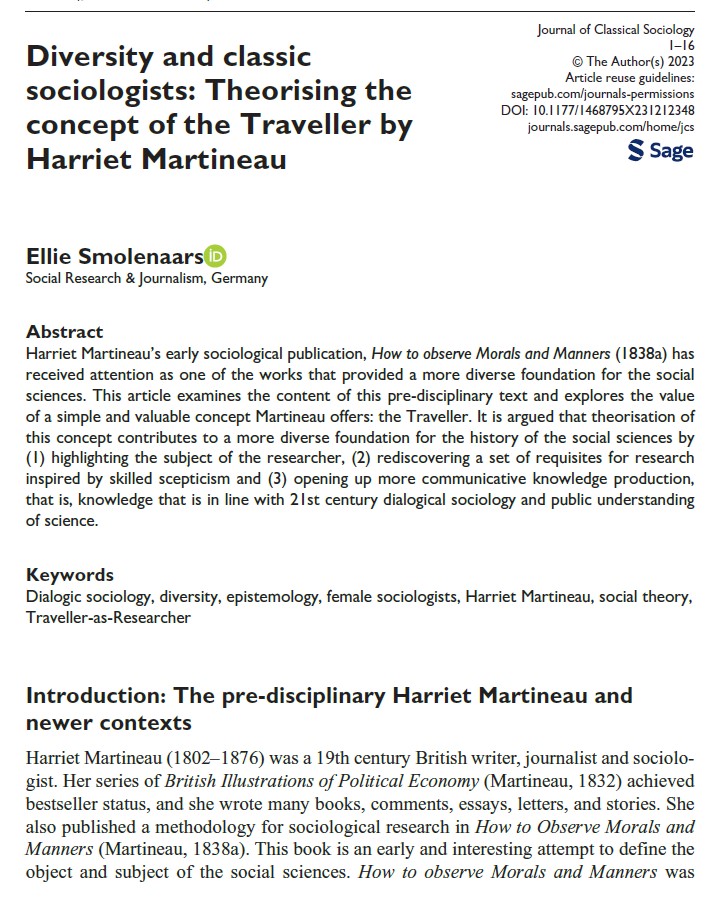
What skills should researchers learn? And what makes social scientists’s observations different from those of other people, or from learning machines? Interesting conceptual answers can be found in a fascinating period in the history of the social sciences: the early 19th century. In this article published in the Journal of Classical Sociology (online first November 2023) I explored The concept of the Researcher-as-Traveller to hopefully open up this question: Can anyone (or anything) observe in an almost scientific way? The works of early sociologist and writer Harriet Martineau are enlightening. Are you curious about the diverse history and foundations of the social sciences? And about doing social research? Please join me on this research journey! Follow the DOI-link for the article at Sage, or read the very short summary below.
Smolenaars, E. (2023). Diversity and classic sociologists: Theorising the concept of the Traveller by Harriet Martineau. Journal of Classical Sociology, 0(0). Online first. https://doi.org/10.1177/1468795X231212348
Summary
Early sociologist and writer Harriet Martineau offers a promising theorising concept – the Researcher-as-Traveller – capable of providing the history of social sciences with more diverse foundations:
- First by emphasising the subject of the researcher. The scientist is not yet an institutionalised person but a free traveller who, as her list of required research skills later shows, can train herself to observe better. Martineau thus develops her argument from the perspective of the spontaneously observing traveller to the more skilled observer.
- Second, Martineau offers a list of 15 requisites for becoming a better observer and introduces the concept of the Traveller, which is used as a metaphoric concept and corresponds to the current position of the researcher. These – philosophical, moral and mechanical – skills, so I argue, contain a key statement: There is no difference between people and readers, between Travellers and the scientist. The concept of the Researcher-as-Traveller thus brings in the reflected self and is in interaction with the researched, the ‘others.’
- Third, it is Martineau’s intention to communicate with respondents and readers, opening up a more communicative production of knowledge, that is, knowledge that is in line with 21st century dialogical sociology, citizen science, and public understanding of science. It was only at the end of the 19th century, with the Atlanta Sociological Laboratory, and at the beginning of the 20th century, with the Chicago School and then the Frankfurt School of sociology, that the role of the observer was included in analyses. Mainstream distinctions between the observed ‘reality’ and the observer were criticised. Martineau’s pre-sociological work can be seen as part of this historical timeline, as a sociological classic setting a milestone on the way to recognition of the subject and intersubjectivity in social sciences. However, Martineau distinguishes in her writings between the knowing subject and the known object and largely follows a Baconian inductivism: first observe the empirical, then draw conclusions. This empiricism is a core element in her work and may result in describing her work in a longer line leading to critical realism. This line of thought should be followed up in further research.
If you have access to an online academic library, you can read the full article at the Journal of Classical Sociology, along with many other interesting articles. If you have no access, i am more than happy to share the article in 2024 with you as soon as published in print. Follow me here, or just write for a PdF-copy.
 Social Research&Journalism